Same Certificate, Wildly Different Price: The Dirty Secret Behind Ruby Grading Reports
Picture this: you're shopping for a ruby, and a dealer presents you with two stones. Both are certified by a respected gemological lab. Both reports list similar color grades, clarity ratings, and carat weights. The prices? One is $8,000. The other is $22,000. When you ask why, the dealer gives you a vague answer about "market demand" and moves on.
Here's the thing — that price gap isn't random, and it's not just dealer markup. It's the direct result of how profoundly subjective ruby grading actually is, and how much the official reports don't tell you. At Ruby Group Shop, we've made it our mission to help collectors and buyers cut through the noise, so let's talk about what's really going on inside those glossy lab documents.
The Standardization Myth
Diamond grading has the GIA's 4Cs — a framework that, while imperfect, gives buyers a reasonably consistent language across the market. Ruby grading has no such universal standard. The Gemological Institute of America, AGL (American Gemological Laboratories), Gübelin, and GRS (Gem Research Swisslab) all use different terminology, different thresholds, and — critically — different philosophies when it comes to evaluating color and treatment.
What one lab calls "vivid red" another might describe as "strong red." What one report flags as "minor heat treatment," another might categorize simply as "indications of heating." These aren't just semantic differences. They translate directly into price. A stone labeled "no heat" by one of the top Swiss labs can command a 30–50% premium over an otherwise identical ruby that received a more ambiguous treatment notation — even if the actual degree of treatment was nearly the same.
For buyers who assume a certificate equals a definitive, objective truth, this is a rude awakening.
Fluorescence: The Factor Nobody Talks About
Open up most ruby grading reports and you'll find a fluorescence notation buried near the bottom, often listed as "strong" or "inert" with little explanation. Most buyers skim right past it. That's a mistake.
Rubies fluoresce under ultraviolet light because of chromium — the same element responsible for their red color. A strong red fluorescence can actually make a ruby look more vibrant and alive in certain lighting conditions, particularly in natural daylight. This is part of why Burmese rubies, which tend to fluoresce intensely, are so prized. Under UV-rich outdoor light, they practically glow.
But here's the catch: that same fluorescence can make a stone look slightly washed out under certain artificial lighting — the kind you'd find in many American homes and offices. Two rubies with the same color grade on paper can look strikingly different depending on where you're viewing them. Dealers who know their stones will price accordingly. Buyers who don't understand fluorescence often can't figure out why one stone "just looks better" and end up overpaying without knowing exactly what they're buying.
Treatment Visibility and the Lighting Game
Almost all rubies on the market today have been heat-treated to improve color and clarity. That's not a scandal — it's an accepted industry practice, and treated rubies are perfectly legitimate purchases. What matters is the degree of treatment and whether it's been accurately disclosed.
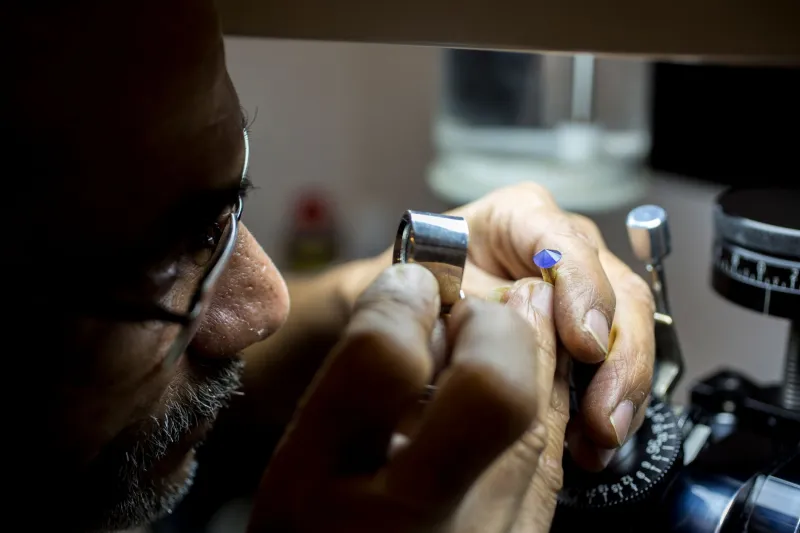
Here's where things get murky: some treatments are only visible under specific conditions. Fracture-filled rubies, for instance, may look clean to the naked eye and even under basic magnification, but reveal their filling under fiber-optic or darkfield lighting. A reputable lab will catch this. A less thorough evaluation might not.
Savvy buyers — and experienced dealers — know to ask how a stone was examined, not just what the report says. A certificate issued without UV testing or advanced spectroscopic analysis is a much weaker document than one that includes those steps. The report might look identical on the surface, but the depth of examination behind it varies enormously.
This is one area where the lab's reputation genuinely matters. Reports from Gübelin or AGL tend to carry more weight in the high-end market precisely because their evaluation protocols are more rigorous and their treatment disclosures more granular.
Gemological Philosophy and the "Origin Premium"
Origin is perhaps the single biggest wildcard in ruby pricing, and it's also one of the most contentious areas in gemological evaluation. A Burmese (Myanmar) ruby with a credible origin determination can sell for two to three times the price of a chemically identical stone from Mozambique or Madagascar — even if both are untreated and equally beautiful.
The problem? Origin determination is not an exact science. It's based on trace element analysis and inclusions, and different labs sometimes reach different conclusions about the same stone. There are documented cases of rubies receiving Burmese origin reports from one lab and "undetermined" or even non-Burmese designations from another.
For collectors investing serious money, this ambiguity is a real risk. It also means that a stone with a prestigious origin report from a top-tier lab commands a premium that goes beyond the ruby itself — it reflects confidence in that lab's methodology. Two identical certificates from two different labs are not, in practice, equal documents.
Reading Between the Lines: What to Actually Look For
So what should a US buyer actually do with all this information? A few practical takeaways:
Check which lab issued the report. For rubies above $5,000, prioritize reports from AGL, Gübelin, GRS, or GIA. Avoid making major purchases based solely on lesser-known lab certificates.
Look at the treatment language carefully. Phrases like "indications of heating" versus "no indications of heating" represent a massive price difference. Make sure you understand exactly what the report is saying — and ask your dealer to explain it plainly.
Ask about viewing conditions. If you're buying online or in a showroom with controlled lighting, request photos or videos of the stone in natural daylight. Fluorescence behavior matters, and you deserve to see it.
Don't conflate certification with valuation. A certificate describes a stone's characteristics. It does not tell you what the stone is worth in the current market. For significant purchases, a separate appraisal from an independent gemologist is worth every penny.
Ask about the examination methodology. A good dealer should be able to tell you what testing was performed. If they can't — or won't — that's a red flag.
The Bottom Line
Ruby grading is as much art as science, and the industry's reliance on lab reports as a shorthand for value has created a system that's ripe for misunderstanding — sometimes innocent, sometimes not. Two identical-looking certificates can represent very different levels of scrutiny, very different treatment histories, and very different market realities.
At Ruby Group Shop, we believe that an informed collector is a protected collector. Understanding the limitations of grading reports doesn't mean distrusting the system — it means using it wisely. The most successful ruby buyers aren't the ones who trust paper blindly. They're the ones who know how to read between the lines.